
Your Outdated Phone System Is Costing You Customers in 2026

Key Takeaways
An outdated phone system costs a typical 10-person SMB $50,000–$130,000 per year in missed calls, productivity loss, line fees, and customer churn, not just repair bills
85% of callers who reach voicemail never call back. That's the single largest hidden revenue leak in legacy phone environments
AT&T ended copper Public Switched Telephone Network (PSTN) support in 20+ states in late 2025. If you're on analog lines in an affected state, this is a compliance and continuity emergency, not just a cost conversation
Switching from legacy Private Branch Exchange (PBX) to hosted Voice over Internet Protocol (VoIP) saves most SMBs 50–75% on direct line costs. Factor in recovered revenue and payback hits 3–6 months
Use the revenue-leak formula in this post to put a real dollar figure on your losses: multiply monthly missed calls by average deal value, then by 0.85. Do it before you finish reading
Why Your Old Phone System Is Losing You Customers Right Now
Most owners don't think of their phone system as a revenue problem. It is. Every gap between the moment someone tries to reach you and the moment they give up costs money. Missed calls, busy signals at peak hours, voicemails nobody checks, dropped calls mid-sale, each one is a customer who just dialed your competitor. Legacy phone system losses aren't limited to the technician's invoice. They compound silently across missed revenue, customer churn, and brand damage every month.
I've spent 25 years working with businesses across every vertical. The pattern never changes: owners fix the leaky roof and the broken HVAC but leave a phone system from 2011 handling their customer intake. They don't see it as a revenue problem. By the time they do, they've bled six figures.
According to CRMXchange and Grammarly's State of Business Communication research, poor communication costs businesses $12,506 per employee per year in lost productivity. For a 10-person team, that's $125,060 annually, before a single missed sales call. That number has independent support. Harvard Business Review identifies communication breakdown as one of the leading drivers of operational inefficiency in small and mid-sized businesses, which means infrastructure decisions sit directly in the path of your margin.
This connects directly to the $126K mistake small businesses are still making. Read that piece for the full financial picture of inaction.
One more factor that makes 2026 different: AT&T ended copper PSTN support in over 20 states during late 2025. If your business is on analog lines in an affected state, this isn't just a savings conversation. It's a compliance and continuity emergency. The FCC's ongoing PSTN transition framework outlines exactly what protections businesses can and cannot expect as copper infrastructure is decommissioned nationwide.
This post gives you a concrete revenue-loss framework, a 10-point self-assessment checklist, and a comparison table competitors aren't providing. You'll leave with a real number and a real plan.
85%
of callers who reach voicemail never call back, they contact a competitor instead
$12,506
lost per employee annually due to poor business communication (CRMXchange/Grammarly)
20+
US states where AT&T ended copper PSTN support by late 2025
75%
average cost reduction reported by businesses switching to SIP trunking or VoIP
The Hidden Costs of Keeping a Legacy Business Phone System
Most owners think phone system costs mean the repair bill. The real accounting looks nothing like that. Seven categories of loss exist, and most businesses bleed from at least four simultaneously.
Category 1, Direct maintenance and hardware. Legacy PBX parts become harder to source and more expensive as the system ages. Traditional copper lines run $50–$100 per line per month. Hosted VoIP runs $15–$45 per user per month. For a 10-seat office, that gap alone is $550–$650 per month, up to $6,600 per year in direct savings before anything else.
Category 2, Opportunity cost of missed calls. 85% of callers who reach voicemail do not call back. Run the formula: monthly missed calls × average deal value × 0.85 abandonment rate = monthly revenue leak. A business missing 40 calls a month with a $300 average deal loses $10,200 every single month.
Category 3, Employee productivity loss. $12,506 per employee per year. Ten employees. $125,060 annually. Capturing even 25% of that through better communication tools is a $31,265 annual gain. A McKinsey Global Institute analysis of workplace productivity found that improved collaboration tools raise knowledge worker output by 20–25%. Better infrastructure translates directly to measurable productivity gains. That's not a theory, it's a documented outcome.
Category 4, Security breach exposure. Legacy systems run unpatched firmware. Secure Telephone Identity Revisited (STIR/SHAKEN) non-compliance exposes businesses to FCC penalties and caller-ID spoofing liability. These are risks that have grown substantially in recent years. The FCC's STIR/SHAKEN implementation mandate requires all voice service providers to implement call authentication technology. Businesses on non-compliant legacy infrastructure face direct regulatory exposure.
Category 5, Regulatory risk. FCC PSTN transition deadlines and copper sunset rules create real legal and operational exposure for businesses on analog lines in affected states.
Category 6, Widening competitive gap. Per Cox Blue's analysis of Moore's Law applied to telecom, communication technology capability roughly doubles every two years. Here's what that means practically: a competitor who upgraded 18 months ago can handle twice the call volume, route calls intelligently across devices, and never miss a lead after hours. Every quarter you stay on legacy infrastructure, that gap gets harder to close.
Category 7, Customer lifetime value erosion. One dropped call during a sales conversation. One busy signal at peak hours. One missed callback. Each can end a customer relationship worth $2,400, $5,000, or more in repeat business. Gartner research on customer experience and churn consistently identifies unresolved service friction, including poor phone accessibility, as a primary driver of preventable customer defection. These losses never appear on an invoice. They just quietly end your growth.
See how much businesses are saving by switching to modern communication infrastructure. The numbers are more compelling than most owners expect.
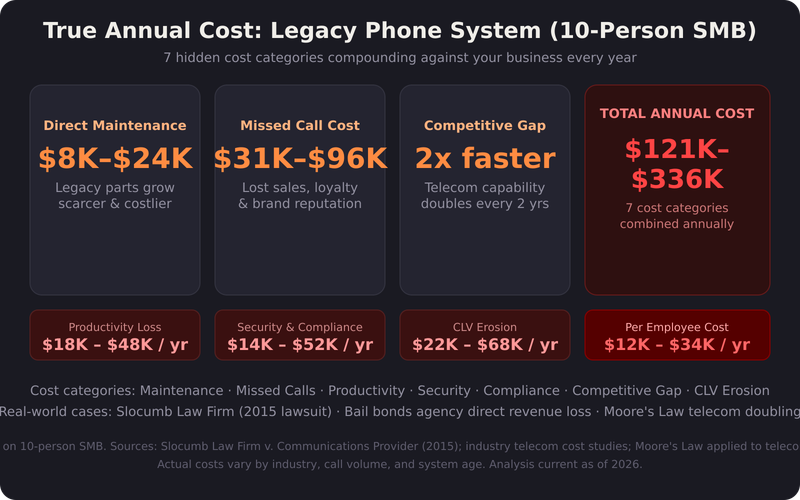
The True Annual Cost of a Legacy Phone System, seven cost categories most owners never calculate
Your Phone System Is Bleeding Revenue Right Now
Want this handled without hiring for it? Luna is our AI operator. She picks up every call live, works every new lead the way you tell her to, and follows up inside the tools you already use.
How Missed Calls and Poor Call Quality Drive Customers Away
Here's the one stat that should stop you cold: 85% of callers who reach voicemail never call back. They don't leave a message and wait. They hang up and Google your nearest competitor.
This isn't just a technology problem. It's a customer experience failure with measurable consequences at every stage of the buyer journey. Harvard Business Review research on response time and lead conversion found that businesses contacting leads within the first hour are seven times more likely to qualify them than those who wait even 60 minutes. That statistic doesn't require much interpretation. Every minute your phone goes unanswered is a direct hit to your conversion rate.
Older PBX systems have a fixed number of physical lines. Hit capacity during peak hours and the next caller gets a busy signal or hold music. At 90 seconds on hold, more than half of callers abandon. Legacy systems can't solve this without expensive hardware upgrades, and patching a broken architecture isn't a strategy.
Desk phones that only ring when someone is physically present create coverage gaps invisible to management. Nobody knows how many calls were lost until a competitor starts consistently winning business you thought was yours.
Map it to the customer journey and the problem compounds. No answer or voicemail leads to hold abandonment. Hold abandonment leads to a repeat attempt. A repeat attempt that also fails leads to a competitor switch, permanently. Every broken touchpoint accelerates that exit.
Put a concrete number on the customer lifetime value (CLV) impact: if an average customer is worth $2,400 per year and you lose three per month to phone failures, that's $86,400 in annual CLV erosion. No invoice captures that loss. It just disappears from your growth curve.
In 2026, employees work from multiple locations and customers expect seamless, fast response. Legacy systems were built for a single physical office with predictable hours and a receptionist at the desk. That world is gone.

10 Signs It's Time to Upgrade Your Business Phone System
If any of the above sounds familiar, run this self-assessment. Answer honestly.
10 Warning Signs Your Phone System Is Costing You Customers
You regularly miss calls during peak hours. Busy signals and voicemail aren't a staffing problem, they're a capacity problem your current system can't solve without expensive hardware.
Your phones only ring at a physical desk. If a call dies when your team is in the field, at lunch, or working remotely, you're losing revenue during every gap in physical coverage.
You have no call routing or auto-attendant. Customers calling after hours or during lunch hear ringing or a voicemail. A modern system answers, routes, and qualifies 24/7 without human intervention.
You can't tell how many calls you're missing. No reporting. No missed-call log. No visibility. If you can't measure it, you can't fix it, and you're flying blind on one of your most critical revenue channels.
Your system requires a technician for basic changes. Adding a line, changing a greeting, or rerouting calls shouldn't require a service call. If it does, your infrastructure is working against you.
You're paying $50–$100 per line per month on copper. Session Initiation Protocol (SIP) trunking and VoIP cut that cost by 50–75%. If you haven't switched, you're paying a legacy tax every single month.
Calls drop during transfers. A dropped call mid-sale or mid-support conversation ends customer relationships. If this happens more than once a month, it's a system failure, not a fluke.
You're in a state where AT&T ended PSTN copper support. This isn't a preference, it's a continuity issue. Check your state. If you're affected and still on analog, your business continuity plan has a hole in it.
Remote employees are completely cut off from the phone system. If your team working from home uses personal cell numbers or has no access to the business line, you have a fragmented customer experience and zero call visibility.
You haven't updated your phone system since before 2020. Communication technology capability doubles roughly every two years. A system from 2019 or earlier is architecturally four generations behind. Competitors who upgraded are faster, more responsive, and closing more of the leads you're both competing for.
If you checked more than three of those boxes, you're not dealing with an aging technology inconvenience. You're dealing with a revenue problem that compounds every month you wait.
Here's your homework before you close this tab. Take your average monthly missed calls, even a rough estimate, and run the formula: missed calls × average deal value × 0.85. That number is your monthly revenue leak from phone failures alone. It doesn't include productivity loss, CLV erosion, or the regulatory exposure from PSTN sunset rules.
For most SMBs, it lands between $8,000 and $15,000 per month.
An AI operator that answers every call and works every lead closes that gap. See how Luna does it. Or keep running the 2011 system. Your competitor would prefer the latter.
Written by
Gary Henderson
Founder of Gary Club
Keep reading