
Let's start with an uncomfortable truth.
If you're a small business owner without an AI voice agent, your phone is costing you more than you think. Right now, a potential customer may have just tried to call, and didn't get through.
They didn't leave a message. They never called back. They Googled the next option on the list and called them instead.
That's not a hypothetical. That's happening to the overwhelming majority of small businesses in America, every single day, and the annual price tag is staggering.
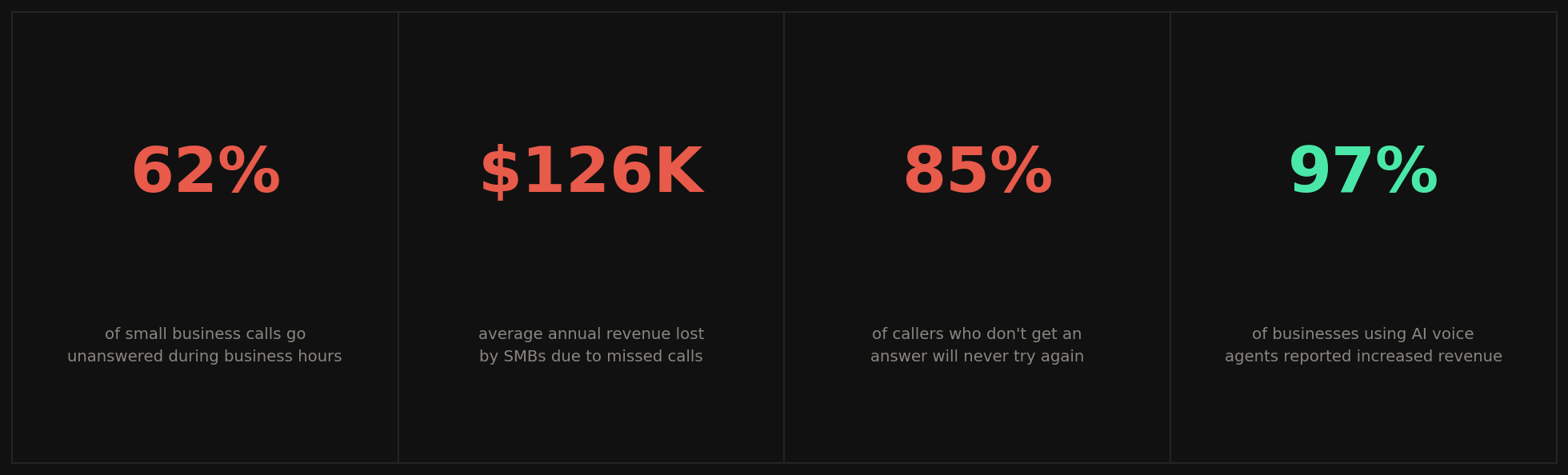
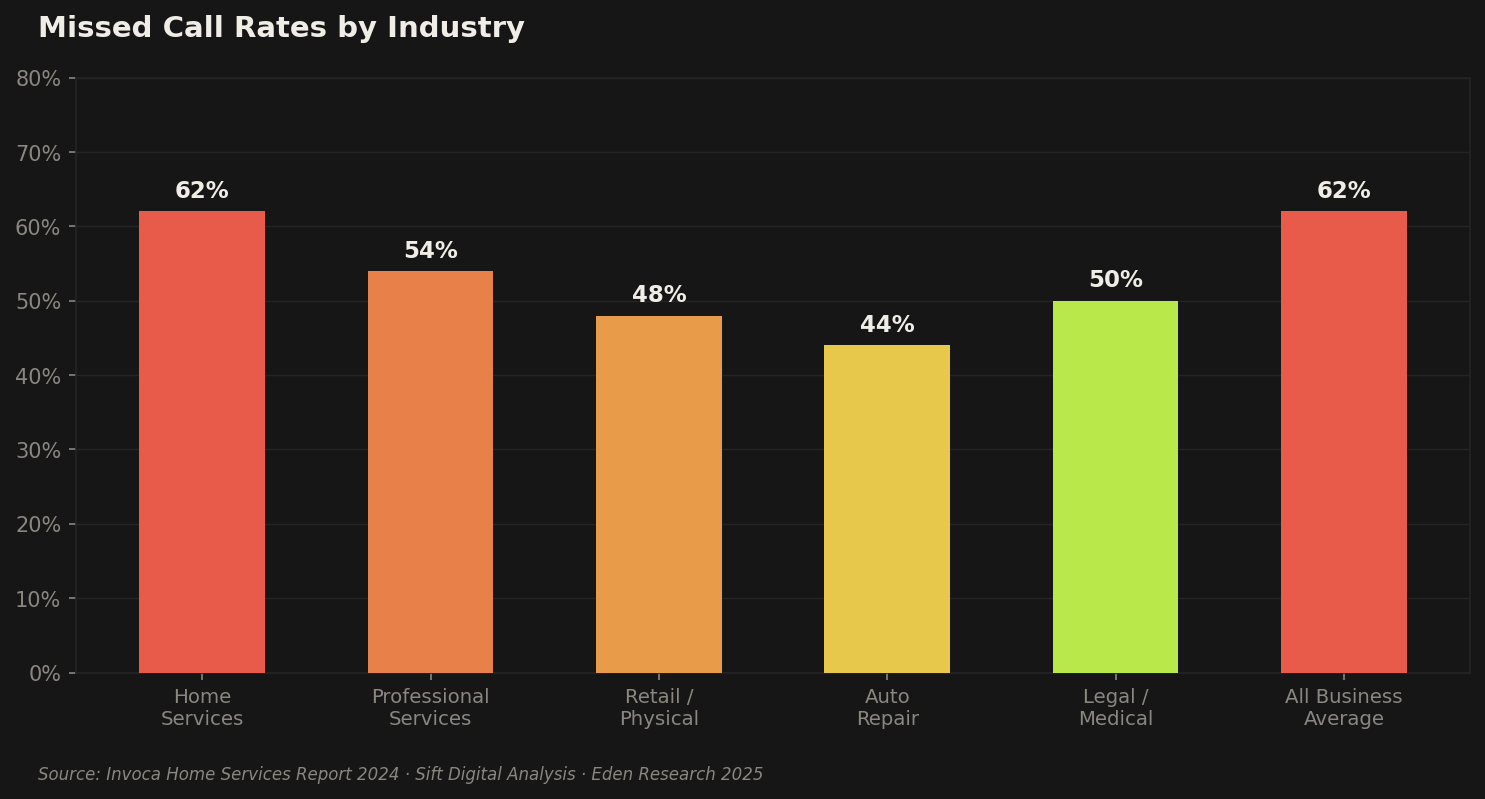
Those aren't made-up numbers to scare you. They come from Invoca's home services research, industry surveys by Vida and Eden, and analysis by data teams across the call-center industry. The pattern is disturbingly consistent across sectors: home service companies miss 62% of inbound calls. Professional services: 54%. Even retail businesses with someone "always at the desk" miss 48% of their calls.
Now here's the other side of that coin: a new class of technology called the AI voice agent, or AI receptionist, answers every single one of those calls. Instantly. 24 hours a day, 7 days a week, 365 days a year. No sick days. No lunch breaks. No turnover. And at a cost that makes a full-time human receptionist look like the most expensive decision you never made.
This isn't a piece about the future of AI. This is about a tool you can have running inside your business by next week, and why, if you're a small business owner in 2025, not having one is a choice you can no longer afford to make.
THE SILENT REVENUE KILLER YOU DON'T SEE ON ANY REPORT
Most business owners track revenue, expenses, and maybe even ad spend ROI. What almost no one tracks is the revenue that never made it to the door, the calls that rang through to voicemail and walked straight to a competitor.
Think about the math for a moment. A study by 411 Locals monitored 85 businesses across 58 industries for 30 days and found these businesses answered only 37.8% of incoming calls. That means nearly two-thirds of potential customers never spoke to anyone. For service businesses where a single job can be worth hundreds or thousands of dollars, that's not an administrative inconvenience, it's a revenue catastrophe.
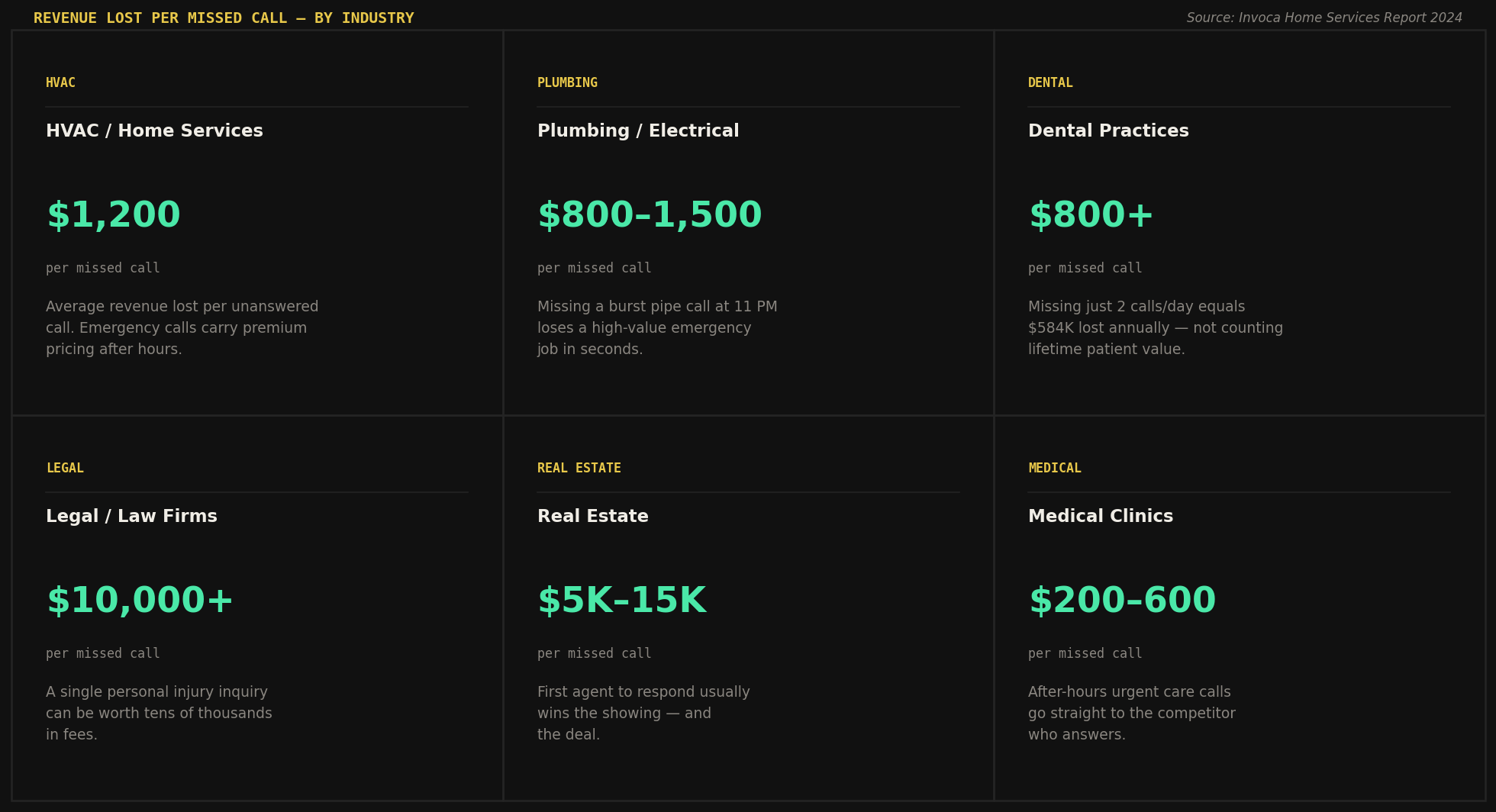
Here's how the per-missed-call math shakes out across common small business categories, based on Invoca's research:
"Every missed call is more than just a number, it's a missed opportunity to serve a customer, close a sale, or build loyalty."
, Aaron Boatin, President, Ambs Call Center
And don't let yourself off the hook with voicemail. Voicemail is not a safety net. Only 20% of callers bother leaving a message, and 67% of people admit they ignore voicemails entirely. Invoca's data shows that less than 3% of callers pushed to voicemail actually leave a message. The other 97% hang up and move on.
The problem isn't effort, it's expectation. Modern consumers, shaped by Amazon, Uber, and instant everything, expect to reach a business the moment they call. 77% of customers expect to reach someone right away when they contact a company, according to Salesforce's 2025 data. And here's a number that might surprise you: 71% of Gen Z, yes, Gen Z, says they'd reach out to customer support via a live phone call when they need help. The preference for real-time voice isn't going away. It's actually intensifying.
WHAT IS AN AI VOICE AGENT, ACTUALLY?
An AI voice agent, also called an AI receptionist or AI answering agent, is software that answers your business phone calls using conversational artificial intelligence and natural language understanding. It's not a phone tree. It's not a scripted IVR system from 2003. It's a voice-powered AI that listens, understands what your caller actually wants, and responds in a natural, human-quality voice.
Think of it this way: it's a virtual employee who picks up every call, knows everything about your business, and either handles the request completely or routes it intelligently to the right person.
What modern AI voice agents can actually do:
Answer Every Call in Under 5 Seconds
24/7/365, no hold music, no queue, no "our offices are currently closed." The AI picks up on the first ring, every time, whether it's 2 PM Tuesday or 2 AM on Christmas morning.
Book Appointments Directly Into Your Calendar
The AI integrates with Google Calendar, Calendly, ServiceTitan, Housecall Pro, and dozens of CRM systems. It checks real-time availability, confirms time slots, and sends booking confirmations, without anyone touching a keyboard.
Answer FAQs With Perfect Accuracy Every Time
Hours, pricing, service areas, availability, policies, anything you configure in the knowledge base gets delivered consistently, without the variance of a stressed front-desk employee on a Monday morning.
Qualify Leads Before They Reach You
The AI asks the right intake questions: what service do you need, what's your timeline, what's your budget, what's your location? High-intent leads get flagged and routed fast. Tire-kickers get handled without wasting your time.
Handle Emergency Routing Intelligently
For service businesses, the 2 AM emergency call is often your highest-value job. AI voice agents can detect urgency, escalate appropriately, and wake up the right on-call technician, not just dump the caller in voicemail.
Log Everything Automatically
Every call gets transcribed, summarized, and logged. You wake up each morning knowing exactly who called, what they wanted, and what action was taken. No post-it notes. No "I think they said Tuesday."
Modern conversational AI achieves 85–95% accuracy for routine business inquiries when properly trained on your specific business. And speech recognition error rates have dropped from 25% in 2015 to under 5% in 2024, the technology has genuinely arrived. These aren't the robotic phone trees of the past. When done right, callers often can't tell the difference.
THE COST MATH THAT SHOULD KEEP YOU UP AT NIGHT
Let's put the numbers side by side. No spin. Just the math.
A full-time receptionist at the median U.S. wage costs $38,480 per year, before you factor in payroll taxes, benefits, health insurance, PTO, training time, turnover cost, and the very real possibility they call in sick on the day your biggest lead ever tries to reach you. All-in, you're looking at $44,000 to $60,000 annually for one person, working one shift, in one time zone, with one mood on any given day.
And they still won't answer the phone at 2 AM when a homeowner's furnace fails in January.
Now here's what an AI voice agent costs:
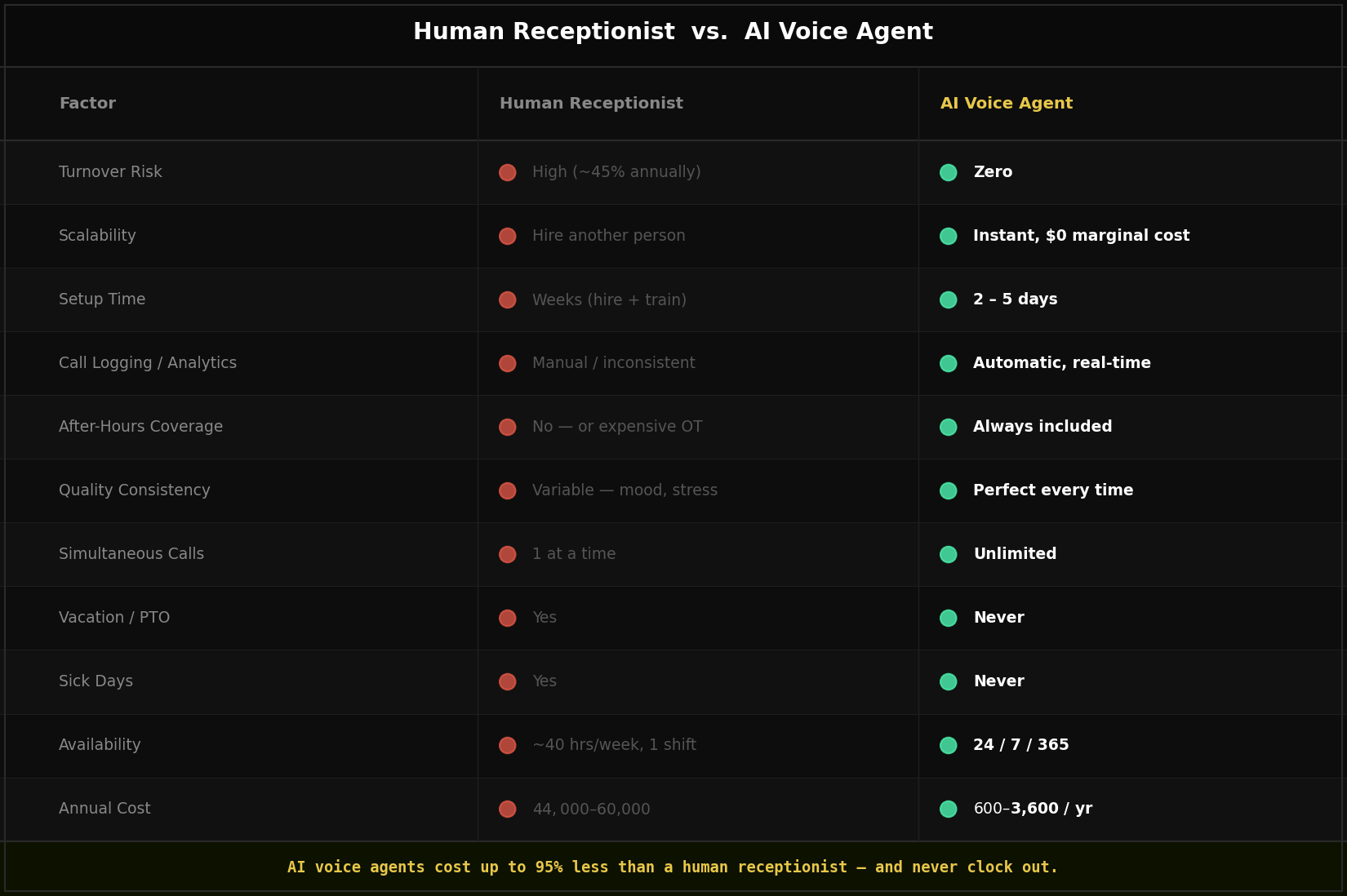
At the low tier of AI voice agent pricing, say $300/month, you're spending $3,600 per year. That's a 95% cost reduction compared to a full-time receptionist. And that doesn't account for the revenue you're now capturing instead of losing.
THE ROI CALCULATION:
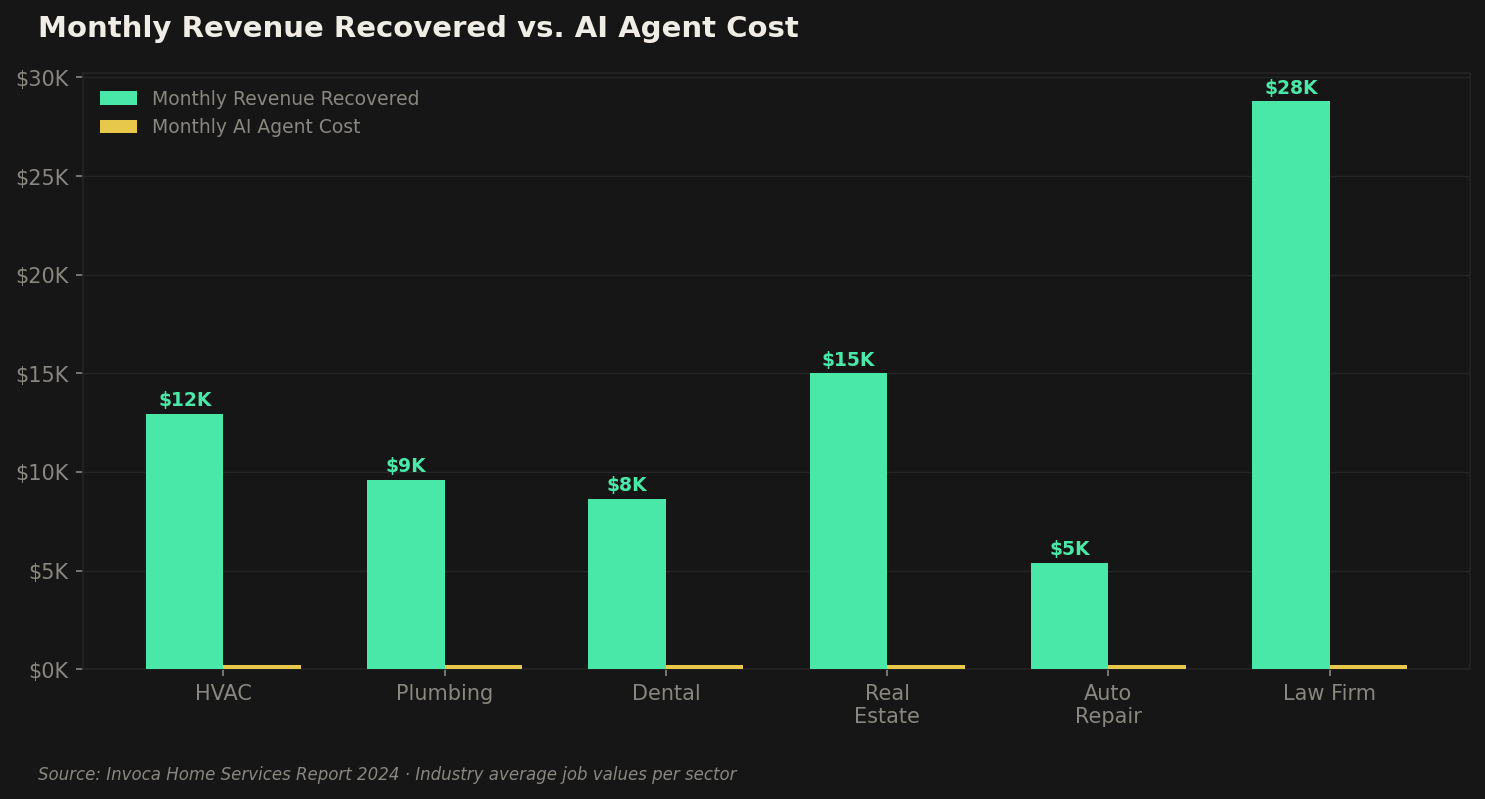
A plumbing company getting 100 calls/month with an average job value of $800, missing 27% of calls (industry average), loses $25,920/month in potential revenue. An AI voice agent at $500/month that captures even half those missed calls adds $12,960/month in recovered revenue, a 6,480% ROI in month one.
REAL BUSINESSES. REAL RESULTS.
Numbers on paper are one thing. Here's what actually happens when small businesses deploy AI voice agents.
The Plumber Who Tripled Emergency Revenue
ProFlow Plumbing, a small operation that was regularly missing after-hours emergency calls, implemented an AI receptionist and saw 200% more emergency calls converted, with $15,000 in additional monthly revenue. Their dispatch time dropped to under 3 minutes. The owner's quote: "Our emergency revenue tripled. It paid for itself in the first week."
The HVAC Shop That Stopped Losing Summer
For HVAC contractors, summer is peak season, and also the time they're least able to answer the phone. A Texas HVAC shop using Podium's AI agent booked 15 extra emergency repairs in a single month purely from after-hours calls that previously went to voicemail. One HVAC owner estimated that a single lost Saturday lead in peak season could cost tens of thousands of dollars.
Molly Maid: 55% Conversion in 30 Days
Molly Maid (a Neighborly brand) implemented an AI receptionist and achieved a 55% conversion rate within the first 30 days, significantly above the industry average of 36%. The single biggest driver: every call got answered. Zero missed inquiries. Zero leads left to competitors.
The Luxury Car Rental That Captured 700+ Leads in 4 Months
Choice Signature Luxury Car Rental was experiencing a painful problem: high call volume, but leads going cold because callbacks weren't recognized. After deploying an AI receptionist, the business captured 700+ qualified leads in four months. The founder's observation: "The leads were screening calls, they didn't recognize the number. The AI answered instantly on the first ring and engaged them before they moved on."
THE SPEED-TO-LEAD PROBLEM AI SOLVES PERMANENTLY
There's a research finding that should be etched into every small business owner's wall: contacting a new lead within five minutes makes them up to 100 times more likely to convert compared to waiting 30 minutes or more.
Read that again. 100 times.
The average small business callback takes over two hours. Podium's analysis of top-converting local businesses found the winners responded in about two minutes. The losers? Two hours. That gap is the entire game for local service businesses in competitive markets.
An AI voice agent responds in under 5 seconds. Every time. On the first ring. While you're on a job, in a meeting, asleep, or on vacation.
Roughly 40% of customer inquiries arrive after business hours, according to Podium's data across their 10,000+ local business customers. Without AI, that's 40% of your potential revenue calling into a void. With AI, that's 40% of your leads getting the same quality experience as your best daytime caller.
"People assume AI is for big tech. But local businesses need it more than anybody, and they're seeing the biggest impact."
, Liam Golightley, VP of Automotive & Enterprise, Podium
WHERE THE INDUSTRY IS HEADING (AND WHY NOW MATTERS)
The AI voice agent market isn't a niche technology play. It's a mainstream infrastructure shift happening right now.
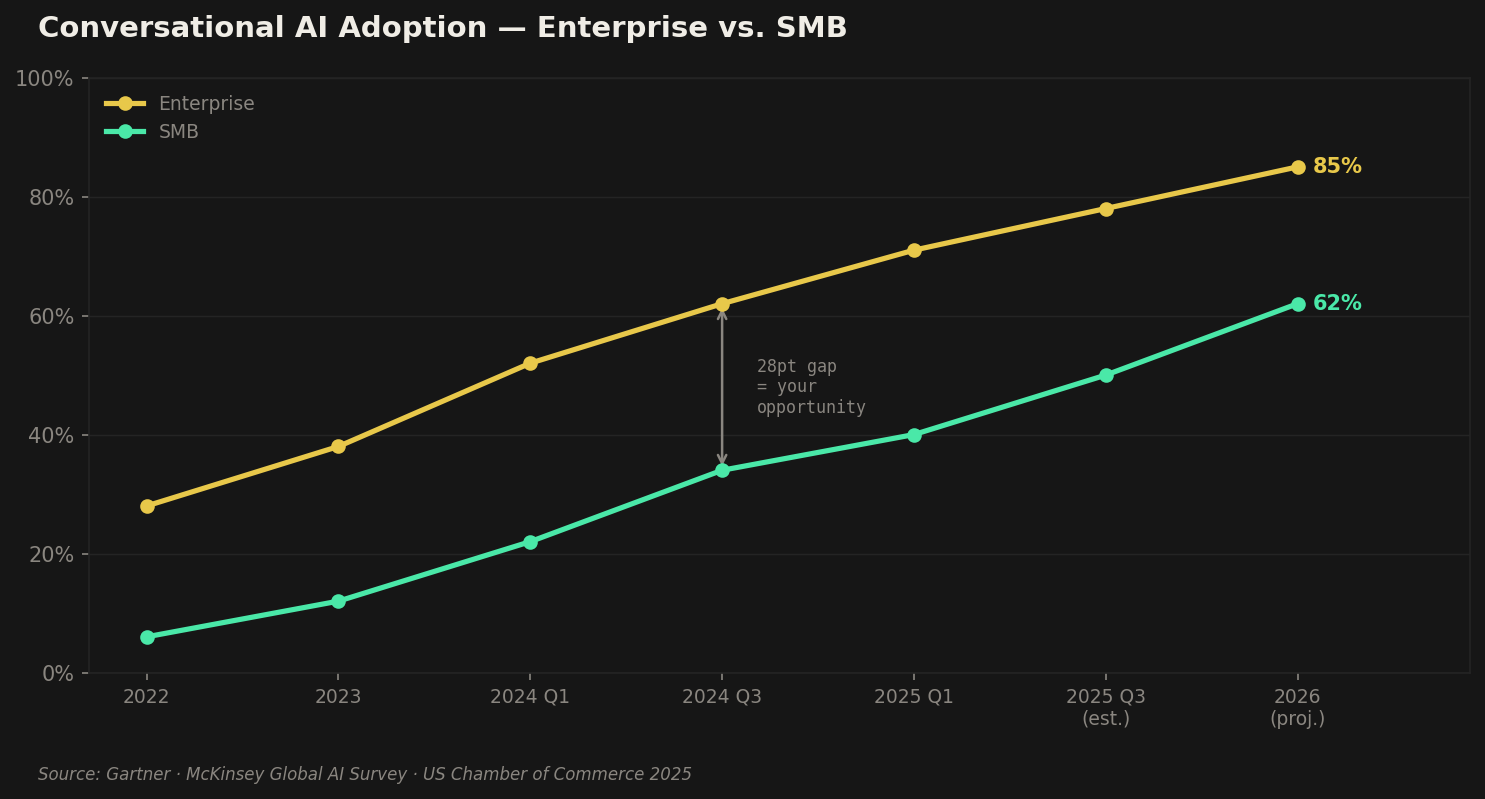
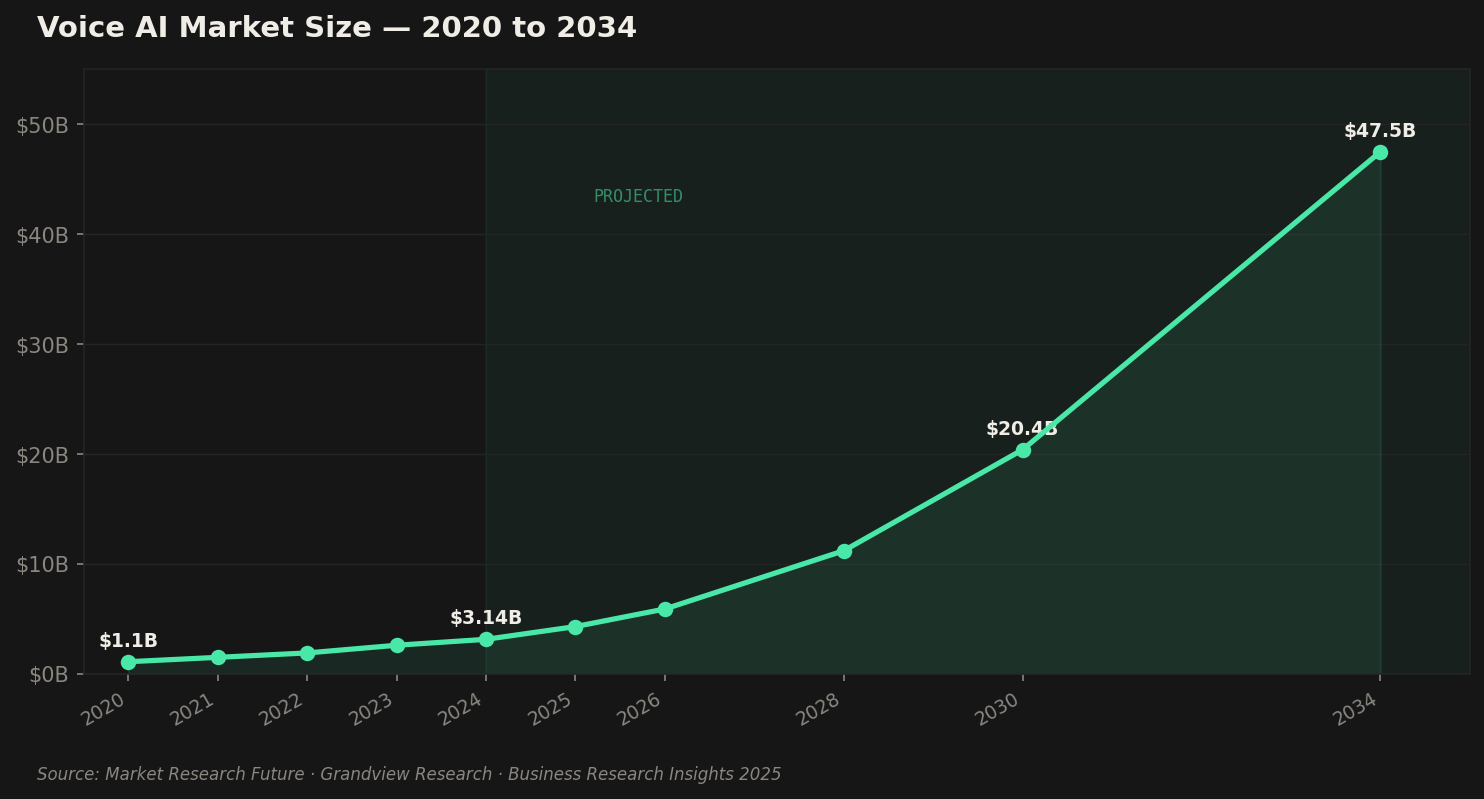
Consider the macro numbers: the global voice AI market is projected to grow from $3.14 billion to $47.5 billion by 2034, a 34.8% compound annual growth rate. Gartner predicts 80% of customer service organizations will use generative AI by 2025. The US Chamber of Commerce found that 58% of small businesses now use generative AI, up from 40% just a year earlier.
The a16z (Andreessen Horowitz) team noted in their 2025 voice AI update that companies building with voice represented 22% of the most recent Y Combinator class. The entire next generation of startup infrastructure is being built on voice-first AI. This isn't a trend you're getting ahead of by adopting now, it's a wave that's already broken. The question is whether you ride it or get rolled by it.
And here's what makes the timing particularly urgent for small business owners: your competitors are already moving. The businesses that deploy AI receptionists now aren't just capturing more calls, they're training their market to expect instant response. Once a customer in your area experiences that a competitor answers on the first ring at 11 PM, "I'll call back tomorrow" stops being an acceptable alternative.
ADOPTION GAP = YOUR COMPETITIVE ADVANTAGE:
Only 22% of SMBs have adopted AI voice agents despite 42% acknowledging they lose money to missed calls every month. That gap is your window. The businesses that close it first build a durable operational advantage that compounds over time, more leads captured, more reviews earned, more referrals generated from better first impressions.
WHAT TO LOOK FOR WHEN CHOOSING AN AI VOICE AGENT
Not all AI voice agents are created equal. Here's what separates a tool that transforms your business from one that frustrates your callers.
Voice Quality Matters More Than You Think
If your AI sounds like a robot from a 2009 phone tree, callers hang up. Modern voice AI should handle natural pauses, interruptions, and casual language without sounding mechanical. Before committing to any platform, call their demo line. If it sounds unnatural to you, it'll sound unnatural to your customers.
Real Calendar Integration, Not Just Message-Taking
An AI that just takes messages and emails them to you is a fancy voicemail, not a receptionist. You need an agent that connects to your actual scheduling system and books real appointments in real time. Look for native integrations with Google Calendar, Calendly, ServiceTitan, Housecall Pro, or whatever you already use.
Industry-Specific Knowledge Bases
The more the AI knows about your business, services, pricing, and policies, the more useful it becomes. The best platforms let you train your agent with specific FAQs, custom responses, and workflow logic that reflects how your business actually operates, not a generic template.
Transparent Pricing Without Hidden Overages
Pricing in this space ranges from $29/month to $2,000+/month. Most small businesses find the $49–$197/month range adequate. Watch out for per-minute billing that can spike unpredictably during busy seasons, setup fees that aren't justified by real onboarding support, and integration fees tacked on top of the base price.
Setup in Days, Not Months
One of the great advantages of modern AI voice platforms over human hires is deployment speed. The best platforms can be configured and live in 2–5 days. If a vendor is quoting you months of implementation, move on.
Escalation Path to Humans
46% of customers will only engage with an AI if there's a clear path to a human when needed. The best AI receptionists handle 80–90% of calls autonomously and hand off gracefully for the complex 10–20% that genuinely need a human touch.
WHO BENEFITS MOST? (SPOILER: PROBABLY YOU)
AI voice agents deliver the best ROI for businesses where:
Call volume is meaningful, if you're getting 20+ calls per month and missing any of them, the math almost certainly works in your favor. The more calls, the faster the payback period.
Average transaction value is high, service businesses, medical practices, legal offices, contractors. The higher your average job value, the more devastating each missed call becomes, and the more powerful the case for 24/7 coverage.
After-hours demand exists, HVAC emergencies, dental pain, legal urgencies, real estate inquiries. If customers have reasons to call you outside of business hours, you're currently leaving that revenue entirely on the table.
Owner-operators are doing it all, if you're the one answering the phone while also doing the work, managing the team, writing the invoices, and running the marketing, an AI receptionist is effectively the highest-leverage hire you'll ever make. It multiplies your capacity without multiplying your payroll.
The businesses where voice AI has the most transformative impact tend to be in exactly the sectors you'd expect: HVAC, plumbing, electrical, dental and medical clinics, real estate agencies, law firms, cleaning services, roofing, salons and spas, and any local service business where phones are the primary inbound channel.
THE BIGGER PICTURE: AI AS BUSINESS INFRASTRUCTURE
Here's the framing shift that changes everything.
AI voice agents aren't a "cool tech feature." They're business infrastructure, in the same category as your website, your CRM, and your scheduling software. Every business eventually got a website. Every business eventually started collecting emails. Every business will eventually have an AI answering their phones.
The only variable is when you make the move, and whether you're ahead of the curve or behind it when that shift in customer expectations fully takes hold in your market.
The data makes the case plainly: 97% of businesses already using AI voice agents reported increased revenue. 82% saw stronger customer engagement. 80% saved five or more hours per week, time that went back into serving customers, closing deals, and running the business instead of sitting near a phone.
A phone that gets answered every time, by a knowledgeable, professional, tireless agent who books appointments, captures leads, and escalates emergencies, at a cost of $2000 to $1,000 per month, isn't a luxury. It's arguably the single highest-ROI operational decision available to a small business owner in 2026.
The phone is ringing. The only question now is whether you're going to answer it.
Start Your AI Agency With AI Agency Unlocked
Learn how to deploy AI voice agents for local businesses, and build a recurring revenue agency around it. Everything you need to get your first client, set up your first agent, and scale.
Written by
Gary
25 years. $1B+ in client revenue. One obsession: helping entrepreneurs stop trading time for money. Gary Henderson is the founder of Gary Club, author of The Clubhouse Creator, and the guy behind the systems that turned coaches, creators, and experts into real business owners. Now he's building with AI and crypto, because leverage just got a whole lot more interesting.
Keep reading