

AI Loops: The Complete Guide to Autonomous Systems in 2026
Last week, I watched a client's autonomous system handle 247 sales inquiries while he slept. Not chatbot responses. Full sales conversations, objection handling, calendar booking.
When he woke up, 31 qualified leads were scheduled for calls.
That's the difference between typing prompts into a chatbot and building systems that work without you. Most business owners are still stuck in the first world, burning hours on back-and-forth conversations with AI. The ones pulling ahead stopped chatting. They started looping.
The unit of leverage in 2026 isn't the chatbot. It's the loop.
Key Takeaways
AI loops run autonomous cycles (goal → context → think → act → check → repeat) while chatbots require constant human input
Terminal loops (Claude Code, Codex) execute specific tasks then exit; always-on loops (OpenClaw, Hermes) run continuously
Hermes Agent's self-improving capabilities with persistent memory make it an appreciating asset that gets better over time
System design - architecting the loop infrastructure, not just prompting - is the critical skill for autonomous success
Autonomous systems represent the practical mechanics of 'stop trading time for money' by creating outcome-based rather than hour-based leverage

Why Chatbots Are Dead
Here's what most people miss about AI in 2026. A chatbot answers when you ask. A loop works while you sleep.
That gap represents the entire difference between staying busy and actually getting free.
Chatbots are reactive. You type a question, it responds. You give it a task, it completes that specific task. Then it stops. Every output requires your input.
You're still trading time for results, just with a faster typist.
Autonomous systems operate on a completely different model. They take a goal, gather context from multiple sources, analyze the situation, take action using available tools, check their own work, and repeat that cycle until the objective is complete.
You set them up once. They run indefinitely.
The math here matters. IEEE Spectrum's analysis shows loop-based automation reduces operational costs by 32% across enterprise systems. But the real leverage isn't cost reduction.
It's time multiplication.
A chatbot trades your time for every answer. A loop trades one goal for an outcome. One keeps you busy. The other buys back your hours.
This shift explains why companies implementing AI voice agent platforms see such dramatic results. They're not just automating conversations.
They're building systems that handle entire workflows autonomously. Sales sequences. Customer service escalations. Lead qualification processes. All running without human supervision.
Skip the Learning Curve
Want this handled without hiring for it? Luna is our AI operator. She picks up every call live, works every new lead the way you tell her to, and follows up inside the tools you already use.
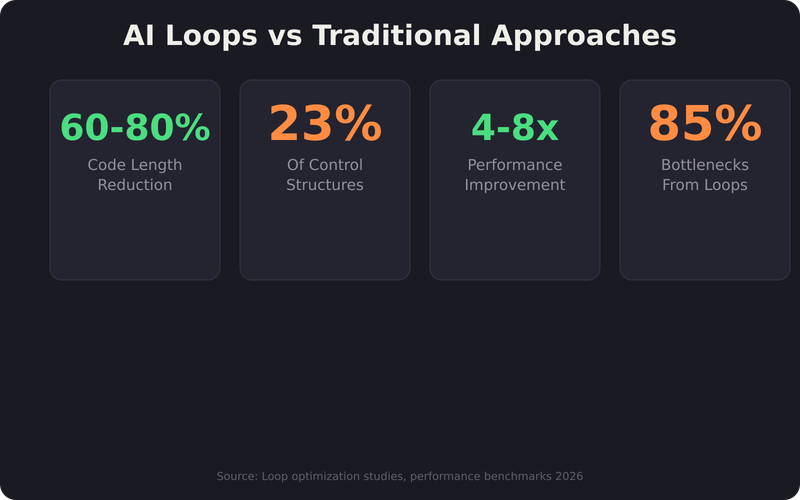
AI loops, AI Loops Performance Stats
The businesses winning in 2026 understand this distinction. They've stopped trying to work more hours and started building things that work without their hours.
How Autonomous Systems Work: Six Steps
Every effective autonomous system follows the same core pattern. Six steps that repeat until the goal is achieved.
Goal Setting: The loop receives a clear objective with defined success criteria. "Schedule qualified sales calls from this lead list" or "Monitor support tickets and escalate priority issues." Specificity here determines everything downstream.
Context Gathering: The system pulls relevant information from databases, email platforms, and real-time sources. This isn't a one-time lookup. The loop continuously refreshes context as conditions change.
Analysis Phase: Using the current context, the system evaluates the situation and determines the next best action. This involves reasoning through multiple options and predicting outcomes.
Tool Execution: The system takes action using available integrations. Sends emails, updates records, makes calls, schedules meetings, processes payments. Real work gets done.
Quality Control: The loop checks its own work against the original goal and success criteria. Did the email send? Did the recipient respond? Is the goal closer to completion?
Iteration Decision: Based on quality control results, the system either continues the cycle with new context or marks the goal as complete.
78%
of routine enterprise tasks handled by automated loops in 2026
60-80%
reduction in development time using terminal loops
2.5x
more likely to exceed targets with rapid feedback loops
The power comes from persistence. Gartner's research shows these systems handle 78% of routine enterprise tasks by 2026. But unlike rigid automation, loops adapt.
When conditions change, the system adjusts its approach while maintaining focus on the original goal.
This framework works because it mirrors how skilled humans tackle complex projects. We don't solve everything in one shot. We work iteratively, gathering new information, adjusting our approach, and checking our progress until we achieve the desired outcome.
The difference is scale and persistence. Humans get tired, distracted, or pulled to other priorities. Autonomous systems maintain focus indefinitely.
Terminal vs Always-On Systems
Understanding loop platforms starts with recognizing two fundamental operating models. Each serves different use cases and requires different infrastructure approaches.
Terminal loops execute then exit. You give them a specific goal, they work through their cycle until completion, then shut down. Perfect for finite projects with clear endpoints.
Development tasks, data analysis, content creation projects.
Always-on loops run continuously. They monitor, respond, and adapt to changing conditions in real-time. Ideal for ongoing business operations, customer service, sales automation, and any process requiring persistent attention.

The choice impacts everything downstream. Resource allocation, monitoring requirements, cost structure, and integration complexity all differ between these models.
Terminal loops require less infrastructure but demand more active management. You need to know when to trigger them and how to chain multiple loops for complex workflows.
Always-on loops need robust hosting and monitoring but provide true "set and forget" automation.
Most successful implementations use both. Terminal loops handle project-based work. Always-on loops manage ongoing operations.
The integration between them creates comprehensive automation that adapts to both planned and emergent business needs.
Stanford's analysis reveals loop optimization can improve execution speed by 15-40%. The improvement depends on the implementation approach. Terminal loops optimize for completion speed. Always-on loops optimize for response time and resource efficiency.
Claude Code vs Codex for Development
Two platforms dominate terminal-based development loops. Both follow the same core framework but serve different scales and integration needs.
Claude Code wraps loop functionality in a command-line interface. You provide a development goal, it reads your existing codebase, writes new code, runs tests, fixes errors, and repeats until the objective is complete. Then it exits.
The strength here is single-developer workflow optimization. Claude Code understands context from your entire project structure, maintains coding standards, and handles the full development cycle from planning to deployment.
No context switching between tools.
Codex coordinates multiple coding agents across longer projects. OpenAI's platform, now running GPT-5.4 for Codex (shipped March 2026), was built to manage fleets of specialized agents working on complex, multi-phase development initiatives.
Where Claude Code excels at focused tasks, Codex orchestrates entire product development cycles. Multiple agents handle frontend, backend, testing, documentation, and deployment simultaneously.
Each agent runs its own loop while Codex manages coordination and conflict resolution.
60-80%
reduction in development time reported by Claude Code users
25%
efficiency improvement in loop-based quantum algorithms
This efficiency gain comes from consistent optimization principles. MIT's programming research demonstrates that loop structures reduce code length by 60-80% compared to repetitive statements.
Development loops eliminate the repetitive context switching that kills developer productivity.
The critical insight: both platforms succeed because they understand that effective development isn't about writing more code faster. It's about maintaining context across the entire development cycle.
Traditional tools force constant context switching. Loop-based development maintains continuity from goal to deployment.
Always-On Systems: OpenClaw and Hermes
While terminal loops handle finite projects, always-on systems manage continuous operations. Two platforms dominate this space with fundamentally different approaches.
OpenClaw operates as a coordination layer for multiple agents. Think of it as air traffic control for autonomous systems. It doesn't do the work directly but manages which agents handle which tasks, prevents conflicts, and ensures optimal resource allocation across your entire infrastructure.
The power here is scale and orchestration. OpenClaw can coordinate dozens of specialized agents simultaneously - one handling customer service emails, another managing social media, a third monitoring support tickets, others handling lead qualification.
Each agent runs its own loop while OpenClaw prevents overlap and optimizes performance.
Hermes Agent takes a different approach: persistent memory and self-improvement. Instead of coordinating multiple agents, Hermes becomes a single, continuously evolving system that gets better over time.
It remembers every interaction, learns from outcomes, and adjusts its approach based on what works. The system builds institutional knowledge that compounds over time.
The distinction matters for implementation strategy. OpenClaw requires more upfront architecture work but scales across complex operations. Hermes requires less setup but becomes increasingly powerful through sustained use.
McKinsey's research on digital feedback loops shows that organizations with rapid feedback loops are 2.5x more likely to exceed performance targets. Both systems excel at rapid feedback, but through different mechanisms.
OpenClaw provides feedback through agent coordination and performance monitoring. Hermes provides feedback through memory persistence and outcome tracking.
The choice depends on whether you need coordinated intelligence or evolving intelligence.
Customer Success: ROI of Closed-Loop Systems
The business case for autonomous loops becomes clear when you examine customer success metrics. Organizations implementing closed-loop feedback systems consistently outperform traditional automation approaches.
Forrester's research reveals that companies with closed-loop feedback systems see 19% increase in customer retention. But the underlying mechanism explains why loop systems deliver superior results compared to traditional automation.
Traditional automation follows predefined rules. When conditions change outside those rules, the system fails. Closed-loop systems adapt.
They detect changes in customer behavior, market conditions, or operational requirements and adjust their approach while maintaining focus on desired outcomes.
This adaptability explains why HubSpot's analysis shows marketing feedback loops generate 4.2x ROI on average. The systems aren't just executing campaigns. They're optimizing campaigns based on real-time performance data.
19%
increase in customer retention with closed-loop feedback systems
4.2x
average ROI from marketing feedback loops
43%
improvement in product development speed with real-time feedback
The ROI compounds over time. Unlike traditional automation that remains static, autonomous loops improve through operation. Each customer interaction teaches the system better approaches.
Each successful outcome refines the process. Each failure becomes learning data for future optimization.
This creates an appreciating asset rather than a depreciating tool. Traditional automation loses effectiveness as conditions change. Loop systems gain effectiveness through exposure to changing conditions.
Implementation Strategy: From Chaos to Systems
Most businesses approach implementation backwards. They start with tools and work toward goals. Successful loop implementation starts with goals and works toward tools.
Step 1: Goal Architecture
Define specific, measurable outcomes for each loop. "Increase leads" isn't a goal. "Schedule 50 qualified sales calls per week from inbound inquiries with 80% show-up rate" is a goal. Specificity determines success.
Step 2: Context Mapping
Identify every data source, system, and touchpoint relevant to your goals. CRM data, email platforms, calendar systems, payment processors, communication tools. Loops need comprehensive context to make intelligent decisions.
Step 3: Tool Integration
Select platforms based on goal requirements and context complexity. Terminal loops for project work. Always-on loops for continuous operations. Coordination platforms when multiple loops need to work together.
Step 4: Success Metrics
Establish clear measurement criteria before implementation. How do you know the loop is working? What data indicates success or failure? Build monitoring into the system from day one.
Step 5: Iteration Protocols
Plan how you'll improve the loops over time. What feedback mechanisms exist? How often will you review performance? What triggers system adjustments?
The businesses succeeding with autonomous systems in 2026 understand that implementation is engineering, not prompting. You're building systems, not having conversations.
The Future of Autonomous Business Operations
Autonomous loops represent more than efficiency improvements. They represent a fundamental shift in how business operations scale.
Traditional business scaling requires more people, more management, more coordination complexity. Loop-based operations scale through better systems.
Add capacity by deploying additional loops, not additional staff.
This changes the economics of growth. Instead of linear scaling (more revenue requires proportionally more people), loop-based businesses achieve exponential scaling (more revenue requires proportionally more systems, but systems don't get sick, quit, or need vacation).
The implications extend beyond cost savings. Loop-based operations provide consistency that human-dependent operations cannot match.
Every customer interaction follows optimized processes. Every lead gets qualified using identical criteria. Every support ticket receives appropriate priority and response.
This consistency creates competitive advantages that compound over time. Your customer experience improves while your costs decrease. Your response times accelerate while your accuracy increases.
Your capacity scales while your complexity remains manageable.
Harvard Business Review's analysis shows that companies with positive feedback loops show 23% higher employee engagement. Counter-intuitively, automation that eliminates repetitive work increases job satisfaction by allowing people to focus on creative and strategic initiatives.
The future belongs to businesses that stop trading time for money and start trading systems for outcomes. AI loops aren't just tools. They're the practical mechanics of that transition.
Stop optimizing your prompts. Start building your loops.
Written by
Gary Henderson
Founder of Gary Club
Keep reading