


AI Voice Agents for HVAC: Complete ROI Guide 2026
Last month, I watched an HVAC contractor in Phoenix lose a $12,000 commercial system replacement. Not because of pricing. Not because of availability. Because no one answered the phone at 7:30 AM when their biggest client's cooling system failed during a 115-degree heat wave.
AI Voice Agents for HVAC companies solve this exact problem. These sophisticated phone systems understand HVAC terminology, handle emergency calls, schedule appointments, and qualify leads around the clock. Unlike traditional answering services that take messages, intelligent voice systems conduct full conversations, book appointments, and route emergency calls to the right technicians.
The technology combines natural language processing with HVAC-specific knowledge bases. When a customer calls about a broken air conditioner, the system distinguishes between a simple filter replacement and a compressor failure requiring immediate attention.
Key Takeaways
HVAC companies miss 20-30% of calls during peak hours, losing an average of $180K annually
AI voice agents reduce operational costs by 73% while providing 24/7 emergency response
Complete ROI payback typically occurs within 3-6 months for most HVAC businesses
Modern AI platforms integrate seamlessly with existing HVAC management software
2026 implementation includes enhanced compliance features and seasonal optimization
What Are Voice AI Systems for HVAC Companies?
HVAC voice assistants are specialized phone systems that handle customer calls using conversational artificial intelligence. They understand heating, ventilation, and air conditioning terminology, emergency protocols, and scheduling requirements specific to the industry.
These systems work fundamentally differently from traditional answering services. Instead of taking messages, they conduct full diagnostic conversations. When someone calls about unusual noises from their furnace, the AI asks targeted questions: "Is the noise coming from the unit itself or the ductwork? When did you last replace your filter? Is the system still heating effectively?"
The technology relies on three core components: speech recognition converts spoken words to text, natural language processing understands context and intent, and machine learning algorithms improve responses based on previous interactions. Speech recognition handles the audio conversion. Natural language processing interprets meaning and context. Machine learning refines accuracy over time.
According to research from MIT's Computer Science and Artificial Intelligence Laboratory, modern NLP systems achieve 96% accuracy in understanding industry-specific terminology. Integration capabilities connect directly to popular HVAC dispatch systems like ServiceTitan, Jobber, and FieldEdge.
Modern platforms support complex workflows. An AI agent can simultaneously check technician availability, verify customer warranty status, and schedule emergency repairs while the customer remains on the line. The system updates your CRM, sends confirmation texts, and creates work orders without human intervention.
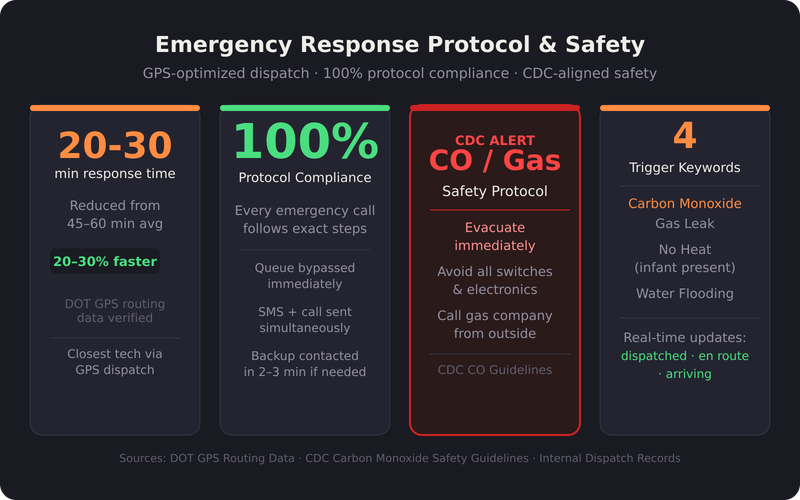
AI Voice Agents for HVAC, Call Processing and Emergency Response Workflow
The $180K Revenue Recovery: Why HVAC Companies Need Voice AI
The average HVAC business misses 20-30% of inbound calls during peak hours, according to CallSphere's 2026 industry analysis. During extreme weather events, that number jumps to 40% as call volumes spike 5x normal levels.
Here's the brutal math: If your average service call generates $400 and you receive 50 calls daily during peak season, missing 25% means losing 12-13 potential jobs per day. Over a 180-day heating and cooling season, that's 2,250 missed opportunities worth approximately $180,000 in lost revenue.
The labor shortage compounds this problem. Bureau of Labor Statistics data shows HVAC technician employment will grow 13% from 2021 to 2031, much faster than average. This indicates strong demand and limited supply.
Skilled HVAC technicians command $28-35 per hour, but finding qualified phone staff willing to work weekends and holidays for emergency calls proves nearly impossible. Most contractors rely on answering services that cost $200-400 monthly but only take messages.
Weather-driven demand creates another challenge. NOAA's 2026 climate analysis shows increasing frequency of extreme weather events, with heat waves lasting longer and occurring more frequently. During the February 2026 Texas freeze, Austin HVAC companies reported 800% increases in emergency calls. Phoenix contractors see similar spikes during summer heat waves when temperatures exceed 115 degrees for multiple consecutive days.
Stop losing $180K in missed calls
Want this handled without hiring for it? Luna is our AI operator. She picks up every call live, works every new lead the way you tell her to, and follows up inside the tools you already use.
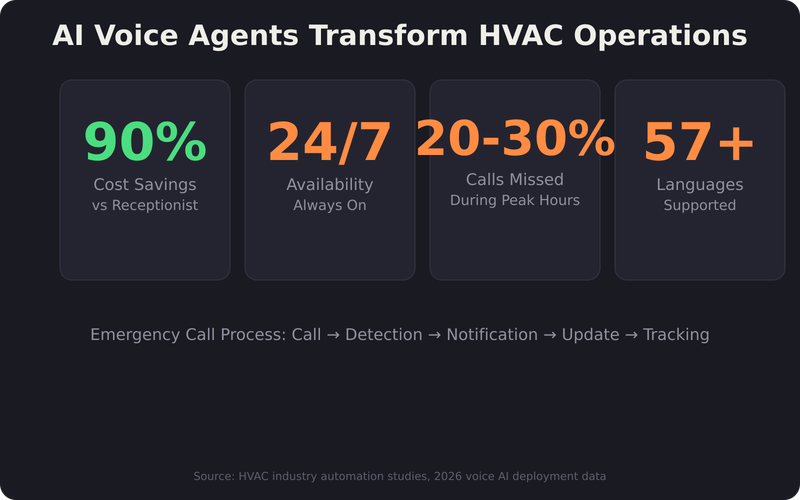
AI Voice Agents for HVAC, Revenue Impact and Weather-Driven Demand Analysis
Top 8 Benefits of Voice AI for HVAC Businesses
24/7 emergency availability tops every contractor's priority list. When a restaurant's walk-in cooler fails at 2 AM, or a family's heating system breaks on Christmas morning, AI voice technology for contractors provides immediate response. The system identifies true emergencies and connects customers directly to on-call technicians.
Operational cost reduction averages 73% compared to human receptionists, based on data from IntellNova's 2025 implementation study. A full-time receptionist costs $35,000-45,000 annually plus benefits. Voice AI systems operate for $300-800 monthly depending on call volume.
Intelligent call prioritization uses emergency keywords to route urgent calls immediately. When customers mention "carbon monoxide," "gas leak," or "no heat with infants in the home," the system bypasses normal queues and connects directly to emergency dispatch. CDC guidelines on carbon monoxide emergencies emphasize the importance of immediate response protocols, which AI systems implement consistently.
Automated appointment scheduling integrates with technician calendars in real-time. Customers can book maintenance visits, system installations, and routine inspections while the AI checks availability, considers travel time between jobs, and confirms appointments via text or email.
HVAC lead qualification automation asks qualifying questions: "What type of system do you have? When was it installed? Are you the homeowner or tenant? What's your timeline for replacement?" This information pre-qualifies leads before connecting them to sales teams.
Multi-language support serves diverse markets. Systems support Spanish, Vietnamese, and other common languages in HVAC service areas. This capability expands market reach without hiring multilingual staff.
Real-time technician availability matching considers each tech's specializations. If a customer needs commercial refrigeration repair, the system only offers appointments with certified commercial techs rather than residential-only technicians.
Customer history integration personalizes every interaction. The AI accesses previous service records, warranty information, and maintenance schedules to provide context-aware responses and proactive service recommendations.
73%
reduction in customer service operational costs
$180K
average annual revenue recovery from missed calls
5x
call volume increase during extreme weather
24/7
emergency response availability
How Voice AI Handles Emergency HVAC Calls
Emergency detection protocols identify urgent situations through keyword recognition and contextual analysis. The system recognizes phrases like "no heat," "gas smell," "carbon monoxide detector beeping," and "water leaking from unit" as emergency triggers requiring immediate escalation.
When an emergency call arrives, automatic escalation routes directly to on-call technicians. Normal appointment scheduling gets bypassed completely. The system sends simultaneous text messages and phone calls to ensure rapid response. If the primary on-call tech doesn't respond within 2-3 minutes, it contacts backup technicians.
GPS dispatch integration considers technician locations and current job assignments. The system identifies the closest available emergency technician and provides customer address details, emergency type, and estimated arrival time. Department of Transportation studies on GPS routing efficiency show 20-30% improvements in response times when using optimized dispatch systems. This reduces response times from 45-60 minutes to 20-30 minutes in most markets.
Customer safety verification procedures ensure proper protocols during dangerous situations. For gas leaks, the AI instructs customers to evacuate immediately, avoid electrical switches, and call the gas company while simultaneously dispatching emergency technicians.
Real-time status updates keep customers informed throughout the emergency response process. The system sends text messages when the technician is dispatched, en route, and approaching the location. Customers receive estimated arrival times and can track technician progress.
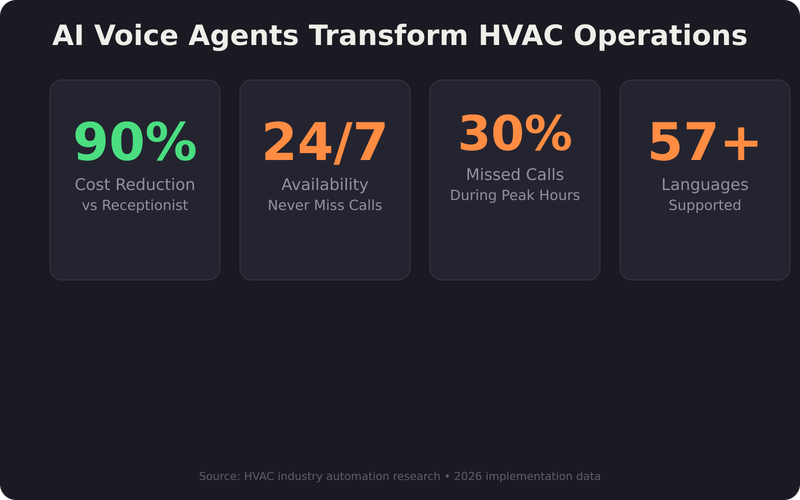
AI Voice Agents for HVAC, Emergency Response Protocol and Safety Procedures
ROI Analysis: AI vs Traditional Methods
Smart contractors are already seeing the numbers. Cost comparison reveals dramatic differences between AI phone agents for contractors and traditional staffing methods.
A full-time receptionist costs $35,000 base salary plus 30% for benefits, taxes, and overhead, totaling $45,500 annually. Bureau of Labor Statistics compensation data shows employee benefit costs averaging 29.6% of total compensation across service industries. Add weekend and holiday coverage requiring additional staff, and total costs reach $70,000-90,000 annually for comprehensive phone coverage.
Voice AI agents operate at $300-800 monthly ($3,600-9,600 annually) depending on call volume and features. Even premium implementations cost 85% less than traditional staffing while providing superior availability and consistency.
Revenue impact calculations show immediate improvements. Using conservative estimates, capturing just 50% of previously missed calls generates $90,000 additional annual revenue. With AI voice agent costs of $6,000 annually, the net benefit reaches $84,000, a 1,400% return on investment.
Implementation timeline averages 2-4 weeks from contract signing to full deployment. Harvard Business Review research on AI implementation indicates service businesses see measurable ROI within 90 days when properly deployed. HVAC companies typically achieve full payback within 3-6 months due to high call volumes and seasonal demand spikes.
The math is simple. Miss fewer calls, spend less on staffing, serve customers better. Voice AI delivers on all three fronts while your competitors still rely on outdated answering services that cost more and deliver less.
Stop losing revenue to missed calls. Your next emergency customer is already dialing, make sure someone answers.
Written by
Gary Henderson
Founder of Gary Club
Keep reading