
Complete Guide to Outbound Voice Sales Optimization 2026
Last week I watched a $2M HVAC company lose a $15,000 commercial job because their sales rep took 3 hours to return a hot lead's call. The prospect had already signed with a competitor who called back in 47 seconds using voice automation.
This isn't rare. It's the new reality of sales in 2026.
Outbound voice sales optimization means using AI voice agents to automate, personalize, and scale your calling campaigns. Manual dialing is dead. Today's top-performing sales teams use smart voice technology to reach prospects instantly, qualify leads systematically, and convert conversations at unprecedented rates.
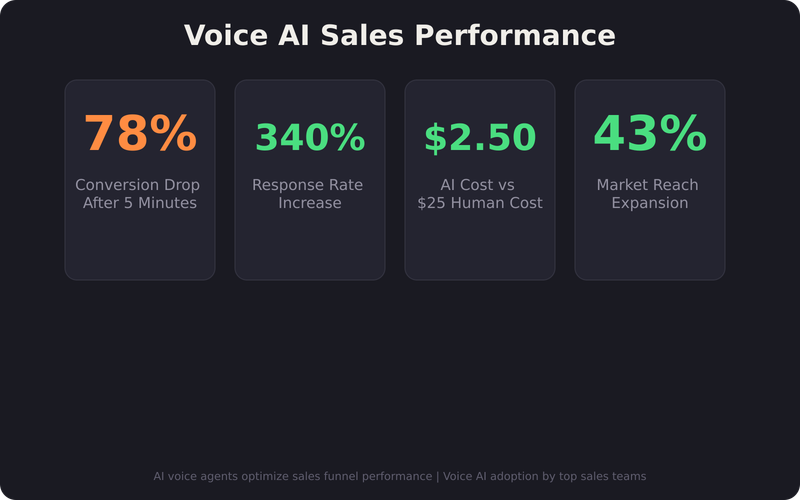
The statistics paint a stark picture. Research shows that 78% of purchase decisions go to the first company that responds. After just 5 minutes, your conversion rates plummet by 78%.
Yet most businesses still operate like it's 2020. They burn through sales reps, miss hot leads, and watch competitors eat their lunch.

We're talking to three specific audiences here. Agency owners who want to add voice automation services to their portfolio and capture the $47 billion outbound calling market. Service business owners, your HVAC, plumbing, electrical, and moving companies, who lose thousands daily from slow lead response.
And online coaches building six-figure businesses who need to qualify high-ticket prospects without burning out their small teams.
This creates a massive opportunity. Voice AI companies see 340% better response rates and 90% lower costs per qualified lead. Early adopters are scaling from 100 calls per day to 10,000+ without adding staff, in just 3-6 months.
Stop Losing Leads to Faster Competitors
Want this handled without hiring for it? Luna is our AI operator. She picks up every call live, works every new lead the way you tell her to, and follows up inside the tools you already use.
Key Takeaways
Voice AI reduces cost per qualified lead by 90% (from $25 to $2.50) while increasing response rates 340%
Implementation takes 1-4 weeks depending on complexity, with most businesses seeing ROI within 30 days
Compliance with TCPA, DNC lists, and consent requirements is mandatory but manageable with proper platform selection
Service businesses, coaches, and agencies see highest returns through instant lead response and appointment automation
Advanced analytics and lead scoring capabilities make voice AI 10x more effective than traditional outbound methods
What Voice AI Sales Means and Why It Matters in 2026
The shift from traditional cold calling to smart voice sales funnels isn't just an upgrade. It's survival.
Your competitors hire more Sales Development Reps (SDRs) and burn through contact lists. Smart businesses deploy AI voice agents that never get tired, never have bad days, and never forget to follow up.
Think about your current outbound process. Sales reps spend 67% of their time on non-selling activities. They're researching prospects, dialing numbers, leaving voicemails, and updating CRM records.
Meanwhile, hot leads go cold and opportunities slip away.
Voice AI flips this equation by automating intelligent conversations and qualifying leads automatically. Human agents focus on closing deals and building relationships. It's not about replacing people, it's about amplifying their impact.
78%
conversion rate drop after 5-minute response delay
340%
increase in lead response rates with voice AI
$2.50
cost per qualified lead with voice AI vs $25 with SDRs
The technology has reached an inflection point. Modern voice automation understands context, handles objections, and adapts conversations in real-time. They integrate seamlessly with your existing CRM and can scale from dozens to thousands of calls without additional infrastructure.
Consider the math on speed-to-lead alone. If your average deal value is $3,000 and you typically close 15% of qualified leads, every hour of delay costs you money.
Voice AI eliminates that delay entirely, calling leads back within seconds of form submission or inquiry.
The competitive advantage extends beyond speed. Voice AI lead generation systems work 24/7, never take sick days, and maintain perfect consistency in messaging. They can handle multiple campaigns simultaneously, calling for appointment setting in the morning, following up on quotes in the afternoon, and conducting satisfaction surveys in the evening.
For agency owners, this represents a goldmine. Businesses desperately need these capabilities but lack the technical expertise to implement them. You can charge $2,000-5,000 monthly for voice automation services that cost you $200-400 to deliver.
How AI Voice Agents Transform Sales Funnel Performance
Your sales funnel has leaks. Prospects slip through cracks between stages, appointments get missed, and follow-ups fall through gaps.
AI voice sales systems plug these leaks systematically, creating a seamless experience that nurtures prospects from first contact to closed deal.
outbound voice sales optimization, Voice AI Sales Performance Statistics
Let's map this stage by stage. Top-of-funnel qualification becomes surgical with voice AI. Instead of sending every lead to expensive human agents, AI handles initial screening. It asks qualifying questions, confirms budget ranges, and validates timing.
Only pre-qualified prospects reach your sales team.
The numbers are compelling. Companies report 85% reduction in manual lead screening time while improving qualification accuracy. AI agents don't skip questions, don't make assumptions, and don't let personality bias influence decisions.
Mid-funnel engagement accelerates dramatically. Your voice AI can call back missed appointments within minutes, offering alternative times and overcoming common objections.
It handles appointment reminders 24-48 hours in advance, reducing no-show rates by 40%.
One of my agency clients implemented automated calling for their pest control business. Their AI agent calls every new lead within 60 seconds, qualifies service needs, and books appointments directly into technician calendars.
Their close rate jumped from 12% to 31% in six weeks.
Bottom-funnel optimization happens through systematic follow-up. Voice AI can call prospects who viewed proposals but didn't respond, address specific concerns mentioned in previous conversations, and present limited-time offers with natural urgency.
The magic lies in the integration. Modern calling strategies sync with HubSpot, Salesforce, and other CRMs in real-time. When a prospect books an appointment through voice AI, it automatically appears in your calendar with full conversation context and qualification notes.
Think about your current funnel conversion rates. Industry averages show that it takes an average of 18 calls to connect with a buyer, and only 2% of cold calls turn into meetings.
Voice AI systems consistently achieve 8-12% conversion rates by eliminating delays, maintaining consistent follow-up, and optimizing conversation flow based on successful patterns.
The personalization capabilities surprise most people. AI agents access CRM history, previous conversation notes, and behavioral data to tailor each interaction. They remember previous concerns, reference past purchases, and adapt their approach based on prospect responses.
Voice AI Implementation: From Setup to Scale
Implementation success depends on getting the fundamentals right before scaling. I've seen too many businesses rush into voice AI without proper strategy.
They end up with poor results and wasted investment.
Start with your CRM integration strategy. Your voice AI platform must sync seamlessly with your existing systems. For HubSpot users, look for native integrations that automatically create contacts, log calls, and update deal stages.
Salesforce implementations require custom field mapping and workflow automation setup.
The technical setup follows a predictable pattern. First, data preparation, cleaning your contact lists, segmenting by qualification criteria, and establishing calling schedules. Second, script development with conversation trees that handle common scenarios and objections.
Third, testing with small batches before full deployment.

Voice script development deserves special attention. Successful scripts follow proven frameworks: attention-grabbing opener, qualification questions, value proposition delivery, and clear call-to-action. But they must sound natural, not robotic.
Here's a proven qualification script structure:
Value hook (7-10 seconds)
Permission question ("Is now good for 2 minutes about...")
Qualifying questions in sequence
Objection handling responses
Clear next steps and booking
The compliance aspect requires careful attention and connects directly to your platform choice. TCPA regulations, DNC list scrubbing, and consent management aren't optional. Your voice AI platform must handle these automatically to avoid legal issues and maintain reputation.
Testing starts small and scales systematically. Begin with 50-100 calls daily to refine scripts, identify edge cases, and optimize conversation flows.
Monitor key metrics: connection rates, qualification percentages, and appointment booking success.
Read ElevenLabs guide on automated calling, but successful implementation requires ongoing optimization. Analyze call recordings, update scripts based on common objections, and continuously refine targeting criteria.
The scaling phase brings exponential returns. Once your system consistently converts at target rates, you can expand to thousands of calls daily without proportional cost increases. Your cost per qualified lead drops while volume and revenue multiply.
The businesses winning with voice AI in 2026 aren't the ones with the biggest budgets. They're the ones who implement strategically, optimize relentlessly, and scale systematically. Your competitors are still hiring more SDRs and hoping for better results.
Stop hoping. Start automating.
Written by
Gary Henderson
Founder of Gary Club
Keep reading