

The Five Minute Window Method: How AI Voice Agents Win the Speed-to-Lead Race in 2026
I've spent 25 years watching companies pour money into paid ads, funnel optimization, and conversion rate testing, then lose 80% of those leads because nobody picked up the phone fast enough.
The problem was never the offer. It was the gap between "they raised their hand" and "you answered."
That gap has a name now. And it has a fix.
This is the playbook I built for our agency operators at Gary Club, and it's generating real lift for real clients who deploy it. The $126K mistake slow follow-up creates is entirely avoidable. This post shows you exactly how.

What Is the Five Minute Window Method?
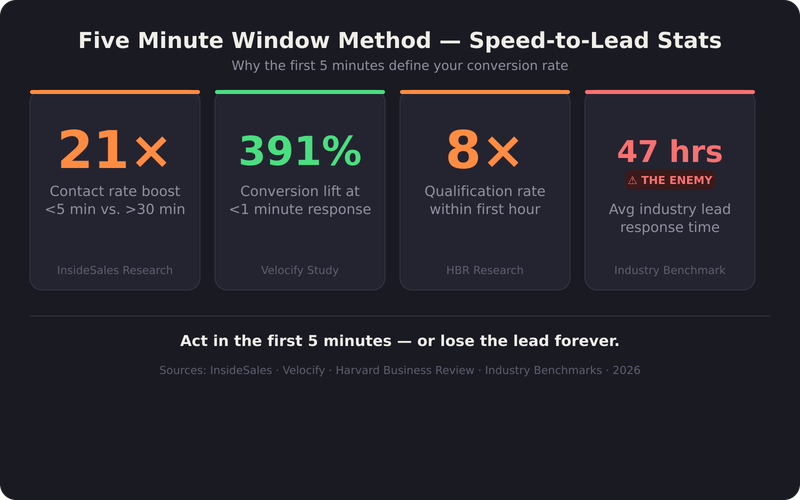
The Five Minute Window Method is a speed-to-lead system that triggers an AI Voice Agent outbound dial and a simultaneous SMS within 30 seconds of a prospect's first intent signal. It's built on two decades of lead response research showing that contact within five minutes produces a 21× higher qualification rate than contact at the 30-minute mark, and that most businesses never come close to hitting it.
The paradox is stark. Researchers settled this question years ago. Velocify studied 50,000-plus inbound leads and found a 391% conversion lift when callers reached prospects within 60 seconds. Harvard Business Review analyzed 1.25 million leads and found the same pattern: respond in the first five minutes and you qualify at 8× the rate of those who waited an hour. Every serious sales researcher agrees.
And yet the industry-average response time in 2026 is still 47 hours.
That's not a typo. Forty-seven hours. The companies who close the gap, from 47 hours to 30 seconds, don't just improve their conversion rate. They capture the market.
The speed-to-lead window isn't a productivity preference. It's an evidence-based method for cutting through avoidance and lowering the effort required to act, applied at organizational scale. Professionals consistently undervalue brief, defined windows of time, even when the payoff is unmistakable.
21×
Higher contact rate: leads reached within 5 minutes vs. 30 minutes, InsideSales research
391%
Conversion lift when first contact happens within 60 seconds, Velocify, 50,000+ leads
47 hrs
Industry average inbound lead response time, 2026
78%
Of buyers choose the first vendor to respond, speed-to-lead is winner-take-most, not a marginal edge
That data makes the case. If your outbound voice sales optimization strategy doesn't start with response time, you're optimizing the wrong variable.
The Buyer-Intent Decay Curve
Here's what competitors never show you: buyer intent doesn't fade slowly. It falls off a cliff.
The decay law is brutal. Every additional minute past the five-minute mark roughly halves your conversion probability. By minute 10, you're in single digits. By hour one, you're fishing in someone else's pond.
Here's why the window closes so fast in 2026: the average prospect's day is fragmented. Notifications, short-form content, and group chats chop their attention into tiny pieces. The moment they submit your form, you have a narrow slot before something else grabs them. That's the window. Miss it and you're interrupting a new conversation, not continuing the one they started with you.
Thinking in fixed, defined time windows, not open-ended hours, is where real output gains are made. The same principle applies to lead response architecture. Build the system around the window, not around human availability.
Speed-to-lead decay curve: conversion probability by response time. Contact within 60 seconds produces a 391% lift; most businesses respond at 47 hours, well past the point of recovery.
Here's what the decay curve looks like, second by second:
Time | Intent | Detail |
|---|---|---|
0–60 sec | Peak intent | They're still on your tab. Still engaged. Reach them now and you're continuing their conversation, not interrupting it. |
1–5 min | Golden window | Still hot, still high-context. The 21× lift lives here. |
5–10 min | Sharp decay | Tab closed. Competitor's site open. You're now an interruption. |
10–60 min | Cold ground | Conversion has dropped 80% from peak. Most operators only enter here. |
1–24 hrs | Stranger territory | If they remember your form, they're comparing you to whoever already called. |
24+ hrs | Effectively dead | The 47-hour average means you're mostly chasing leads who converted elsewhere. |
Five structural reasons most businesses never close this gap:
Human SDRs sleep. Nine-to-five coverage means 16 hours of daily dead air on every inbound lead.
Routing adds latency. Ticket queues and CRM assignment workflows eat minutes before anyone dials.
Nobody believes the data. A 391% lift sounds like a rounding error. It's not. Disbelief keeps the advantage unclaimed.
The stack isn't wired for speed. Your outdated phone system is costing you leads, not because of call quality, but because it was never built to fire a dial in 30 seconds from a form submission.
Single-call abandon. Most SDR teams stop after one attempt. Contact rate roughly doubles between attempt one and attempt three, spaced correctly.
"Speed-to-lead is the single highest-ROI lever in modern sales. Most companies still take 47 hours. The ones who respond in 60 seconds are eating the entire market.", Gary Henderson
The answer isn't hiring faster humans. Remove humans from the first 30 seconds entirely. Time-boxing research confirms the principle, fixed windows beat open-ended effort. Build your response architecture the same way.
Your leads are decaying right now.
Want this handled without hiring for it? Luna is our AI operator. She picks up every call live, works every new lead the way you tell her to, and follows up inside the tools you already use.
The Three Agents Architecture: How the System Actually Works
The five minute window method runs on three specialized agents, not a single chatbot, but a coordinated architecture where each agent owns a distinct lane.
Agent 1: The Outbound Voice Agent
This fires the moment a trigger event lands. It dials from your client's branded caller ID in under 30 seconds, with sub-800ms response latency (that's under one second from when the prospect stops talking to when the agent replies). It handles objections using LAER, Listen, Acknowledge, Explore, Respond, books calendar slots in real time, and transfers to a human when purchase signals spike.
Think of it like a specialist whose only job is to act in a narrow window. It's ready the moment a trigger fires. Every time. No queue, no delay, no sleep. That's the entire design philosophy, act when the window is open, regardless of what else is happening.
The 10-Point Voice Agent Quality Bar, test your agent against every one of these before pointing real leads at it:
Voice Agent Quality Bar (Minimum 8/10 to deploy)
✓ Sub-800ms end-of-speech to agent-response latency
✓ Natural cadence: pauses, micro-fillers, varied sentence rhythm
✓ Interrupt handling, agent stops and listens when prospect cuts in
✓ Tone-matched to client brand and marketing voice
✓ Knowledge base grounded, pulls from offer page, FAQs, pricing, objections
✓ LAER objection handling (Listen, Acknowledge, Explore, Respond)
✓ Live calendar booking during the call, against real availability
✓ Smart human transfer with full context passed to the rep
✓ Self-identifies as AI if directly asked, clearly, briefly, continues
✓ Post-call summary auto-generated, tagged, dropped in CRM
A bad voice agent is worse than no voice agent. It burns trust and trains prospects to hang up on real callers. Fail three or more markers, fix the agent before it touches a live lead.
Agent 2: The SMS Messaging Agent
Fires simultaneously with the voice dial. It owns every text leg of the sequence: instant welcomes, voicemail follow-ups, no-show recovery, pricing-intent nudges, day-two re-engagement. Brand-voiced. Carrier-compliant. Set it up once and it runs.
Variable key: {{first}} = first name · {{agent_name}} = agent name · {{company}} = business name · {{lead_magnet}} = offer name · {{cal_link}} = booking link · {{pricing_tier}} = plan viewed · {{product}} = item/service · {{day}} / {{time}} / {{tz}} = appointment details
Timing key: T+5S = 5 seconds after trigger · T+5MIN = 5 minutes after trigger · T+2MIN AFTER SCHEDULED = 2 minutes past no-show · T+10MIN = 10 minutes after trigger · T+24HRS = 24 hours after trigger
All 7 SMS Templates, copy, swap variables, ship:
TEMPLATE 01 · FORM-SUBMIT WELCOME (T+5S)
Hey {{first}} — this is {{agent_name}} with {{company}}.
Your {{lead_magnet}} is on its way. I'll ring you in about
30 seconds with two quick questions.
Reply STOP to opt out.

TEMPLATE 02 · BOOKING CONFIRMED (T+5S)
You're booked for {{day}} at {{time}} {{tz}}. I'll call on
this number. Reply CANCEL if plans change — happy to give
the slot to someone who can make it.
Calendar invite: {{cal_link}}

TEMPLATE 03 · VOICEMAIL DROP FOLLOW-UP (T+5MIN)
Just left you a quick voicemail, {{first}}. If texting is
easier, I'm here. Or grab any open slot today:
{{cal_link}}

TEMPLATE 04 · NO-SHOW RECOVERY (T+2MIN AFTER SCHEDULED)
Hey {{first}} — we had {{time}} on the calendar but I
didn't see you pop in. Want to grab another slot today,
or is now still good?
{{cal_link}}

TEMPLATE 05 · PRICING-PAGE HIGH INTENT (T+30S, OPT-IN)
Saw you were looking at {{pricing_tier}}, {{first}}.
Most people on this page have one question I can answer
in two minutes. Reply YES and I'll ring you — or just
text it here.

TEMPLATE 06 · CART ABANDON (T+10MIN)
Hey {{first}} — you left {{product}} in your cart.
Still thinking it over? I can answer questions now or
hold your spot for 24 hours.
Reply YES to chat, or book a call: {{cal_link}}

TEMPLATE 07 · DAY-TWO RE-ENGAGEMENT (T+24HRS)
{{first}}, checking back in. If timing was off yesterday,
I've got slots open this morning.
Worth two minutes? {{cal_link}} — or reply here.
Written by
Gary Henderson
Founder of Gary Club
Keep reading